Music / LORQAI
THE MAP WAS UPSIDE DOWN — The Turn We Didn't Take
A LORQAI song from OUT OF ORDER, IN TUNE, accompanied by “The Turn We Didn't Take,” an original fictional story inspired by the track.
Listen to THE MAP WAS UPSIDE DOWN by LORQAI from OUT OF ORDER, IN TUNE, and read “The Turn We Didn't Take,” an original fictional story inspired by the song.
Before the turn
The first piece of confetti fell out of my shoe when I stepped on the brake.
It was a small silver star. It landed by the pedals and stayed there, flashing each time a car passed us on the highway. I decided not to reach for it. Your jacket was spread across the back seat, the sleeves inside out from the way you had pulled it off, and the radio was warning drivers about storms along the coast.
We had left the wedding a little after ten. The band had still been playing when we slipped out through the side door. Someone had shouted that we were leaving too early, then turned straight back to the dance floor.
In the car, neither of us had much to say.
What everyone wanted to know
It had been a lovely wedding. That was the difficult part. Nothing terrible had happened. The food was good. The speeches were kind. The bride had cried with happiness and the groom had cried because she did. You had danced with me, even during the song you disliked, and I had laughed when you counted the steps under your breath.
But after the speeches, people began asking about us.
Where did we see ourselves next year? Had we made a decision yet? Were we going to stay where we were, or finally change something? They meant well. They spoke with that bright certainty people borrow from a celebration, as though the future were a house you could reserve if you acted quickly enough.
We gave different versions of the same answer. We're thinking about it. Not quite yet. We'll let you know.
On the way to the car, you said you were tired. I said I was too. We had become very good at saying true things that were not quite the truth.
You took an old road map from the glove compartment. It had a tear through the place where two counties met. When you opened it across your knees, north ended up facing you instead of the windshield.
“That's upside down,” I said.
“I know.”
You didn't turn it around.
The exit
The road home was familiar enough that neither of us needed a map. At the last service station before the city, the highway divided into two bright streams of traffic. Our exit was coming. I could have taken it almost without looking.
The radio announcer finished describing a band of rain. The blue sign appeared, grew larger, and began to move above us.
“I think we're going to miss it,” you said.
You said it as a warning, but you were watching me, not the sign.
I kept the car in the outer lane. We passed the white arrow, then the beginning of the ramp, then the last little piece of painted line connecting it to the road.
There was a silence I almost mistook for anger.
Then you let out a small breath.
“Well,” you said. “That's one decision.”
It was the first thing either of us had said all evening that made me smile without effort.
We could have turned around at the next junction. Instead, we followed the road toward the dark hills. There was no dramatic music, no sudden feeling of freedom. The fuel gauge moved a fraction lower. The wipers cleared the windshield. I was still worried about tomorrow.
But for a few miles, tomorrow didn't have to be discussed.
An orange, a postcard, and a shortcut
The petrol station stood alone at the edge of a town we had never visited. Two green-lit pumps faced an empty parking lot. Inside, a refrigerator hummed so loudly that I could hear it over the soft music from the ceiling.
You bought an orange, though neither of us was hungry. Then you found a postcard showing a lake beneath a line of pale mountains.
“Have we been there?” you asked.
I looked at the picture. The water was impossibly blue.
“Not unless we forgot.”
“Good. I was worried we were running out of places.”
The woman at the counter heard us asking about the lake. She drew a shortcut on the map with a blue pen, taking care to avoid a bridge closed for repairs.
“Forty minutes if you go this way,” she said. “Longer if you stay by the water.”
Back in the car, you folded the map along the pen mark. I set the orange in the cup holder, where it rolled gently each time we turned a corner.
At the next fork, I took the road beside the water.
“You heard what she said,” you told me.
“I did.”
“That was the slow way.”
“I know.”
For the first time that night, you laughed.
The things we couldn't put on a map
The road narrowed. We passed a shuttered café, a row of sleeping houses, and a field in which the rain had collected in long black pools. The storm moved east without quite reaching us.
You held the postcard against the window, comparing its mountains to the shapes appearing in the dark. We had no good reason to keep driving, and no good reason to hurry back.
Eventually you said, “Everybody thinks we've already decided.”
I knew what you meant. At the wedding, we had answered questions as though we were discussing train times. In reality, we were talking about the shape of our lives. Change one thing, and other things might have to move with it. There was no neat version in which no one had to give anything up.
“I kept thinking you'd say something,” you said.
“I kept waiting for you to.”
You turned the postcard over. There was nothing written on the back.
We might have argued then. On another night we probably would have. I could feel the first sharp sentence waiting behind my teeth, and I knew you had one of your own. Instead, I asked whether you wanted the window open.
“Just a little.”
Cold air entered the car. It smelled of wet grass and something mineral from the shore.
We drove the next bend without speaking.
By the lake
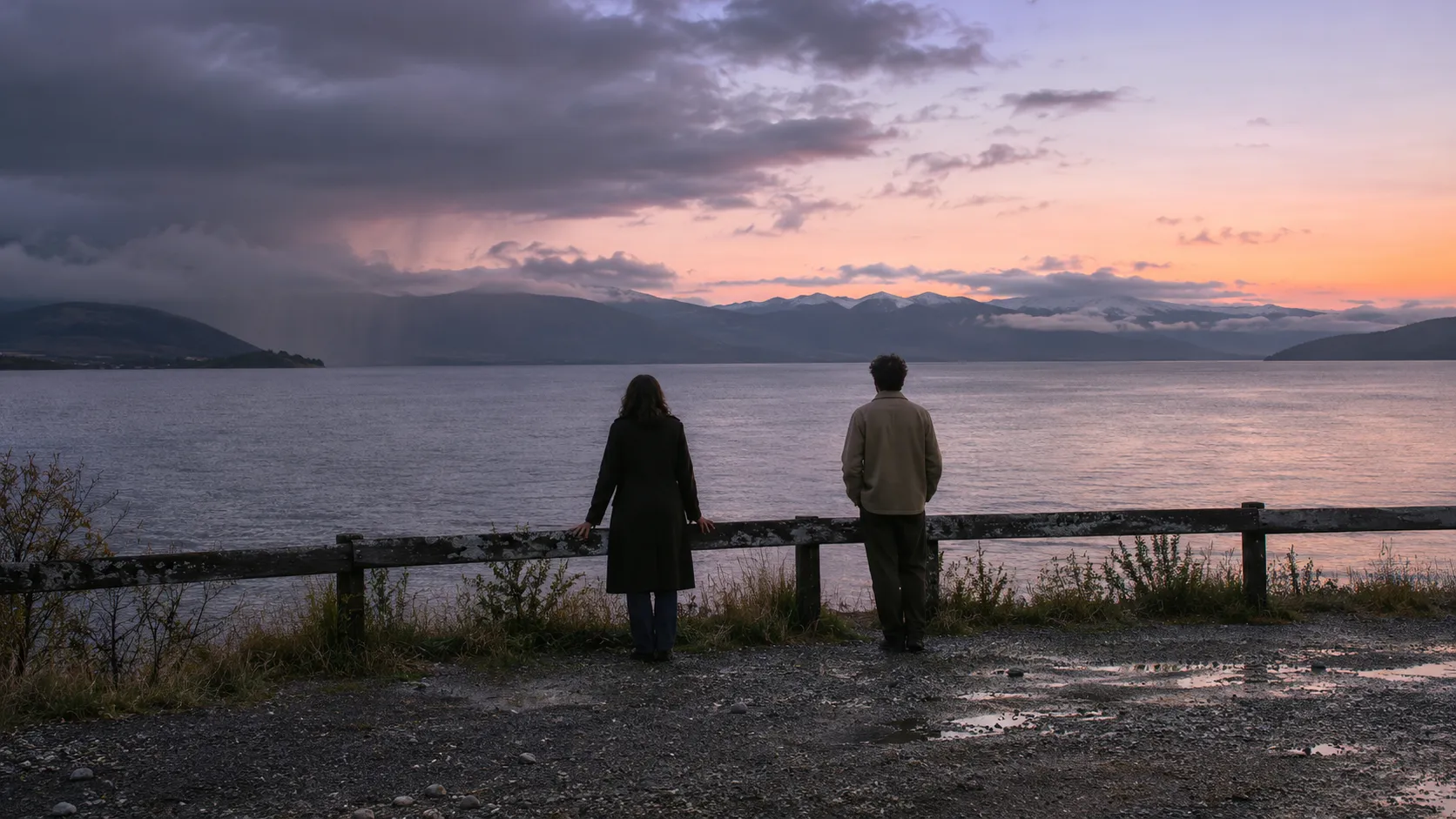
When we reached the lake, the sky was beginning to separate into colors. The water was gray near the shore, faintly pink toward the hills. There was a gravel place to park and a low wooden rail that someone had painted years ago.
We stood beside it while the world grew visible.
The orange was still in the car. We had forgotten about it, and somehow that seemed right. We had bought it because it was there. We had come here for much the same reason.
After a long time, you spoke.
“I'm frightened,” you said, looking at the water, “of how quickly things can change.”
I had spent the whole evening trying to find the reassuring answer. At the wedding I had almost rehearsed it: We'll work it out. There is plenty of time. Nothing will really change. I had wanted to make you less afraid, and I had wanted even more to make myself believe it.
But beside the lake, those words felt too easy.
“Me too,” I said.
You looked at me then. Not because the answer was clever. Because, for once, it was exactly the answer I meant.
We stayed until the first light reached the rail. We didn't decide where we'd live or what next year would look like. We didn't promise that every change would be good. I stopped trying to turn the conversation toward a conclusion simply because silence made me nervous.
When you finally asked if we should head home, I said yes.
This time, it felt like a choice we were making together.
Facing east
The car was cold when we got back in. Your jacket was still on the rear seat. The silver star remained by the pedals. I started the engine and pulled onto the road as the day came up behind the hills.
You rested the folded postcard on the dashboard. The road map stayed across your knees, still upside down.
I knew where the next turning was. So did you.
Neither of us reached to correct the map.
About the Song
- Released
- Album
- OUT OF ORDER, IN TUNE