Music / LORQAI
WHEN THE APPLAUSE WAS OVER — The Train He Didn't Take
An original short story inspired by LORQAI’s “WHEN THE APPLAUSE WAS OVER,” from the album OUT OF ORDER, IN TUNE.
An original LORQAI short story inspired by WHEN THE APPLAUSE WAS OVER: after his mother’s birthday celebration, a son must choose between catching his train and staying to help.
Introduction
The first folding chair made a noise like a saucepan being dropped in an empty house.
I was halfway into my coat when I heard it. The last guests had gone down the stairs, taking the easy noise of the party with them: shoes on the concrete steps, children protesting the hour, somebody calling goodbye twice because the door had already swung shut. In the hall, the lights seemed suddenly too bright.
Mum was standing beside the cake table, trying to fold a chair with one hand. She had her blue wool cardigan draped over the other arm and a strip of silver ribbon caught around her wrist.
“Leave that,” I said. “I'll get it.”
“It's only a chair.”
I looked at my watch. Eight thirty-eight. My train left at nine.
The letter facing the wrong way
We had hired the hall above the old sports court because Mum said she didn't want anyone squeezing into her sitting room. She had said it three times, always in a cheerful voice that made it difficult to disagree.
I arrived just after lunch with a bag and a train ticket for the same evening. My plan was neat: help set up, stay for the speeches, eat some cake, catch the nine o'clock back to the city. I had even worked out which street to take from the hall to the station. My bag would wait under the table near the door. Nothing needed to be rushed.
Jo was already up a ladder, fastening paper stars to the wire above the chairs. A cardboard sign in silver letters announced Mum's birthday. One letter had been fixed backward.
“Do we tell her?” I asked.
“She's the one who put it up,” Jo said. “Leave it.”
Mum came through carrying a box of paper plates and saw me before I could put my bag down. She set the box on the nearest chair and hugged me so firmly that the cardboard made a small crackling noise between us.
“You made the trip.”
“Of course.”
She pulled back and looked at my face for a second, as though checking that I had arrived whole. Then she asked if I had eaten.
I said I had. It was easier than explaining that I'd bought a sandwich at the station and left most of it in its wrapper.
The good part
It was a good birthday. It matters that it was good.
The cousins arrived with paper plates even though we had enough. The children stole the cream from the side of the cake when they thought nobody was looking. Somebody's scarf slipped into the bowl of punch; Jo rescued it with a serving spoon and hung it over a chair to dry. An uncle danced through one song with his hands held carefully in front of him, the way people carry two full cups across an uneven floor.
Mum moved among them with the purposeful attention she had always given a roomful of people. She found another fork when a child dropped one. She kept the kettle on. She remembered which neighbour needed a chair with a back rather than a bench. When the music was too loud for conversation, she turned it down without asking anyone's permission.
I took photographs until she told me to stop.
“Come and sit. You haven't been in one picture all evening.”
“I'll sit in a minute.”
It was a phrase I'd inherited from her, and she recognized it. We smiled at each other across the table.
She didn't like speaking in public. When Jo gave her the microphone, Mum held it near the middle of her cardigan, too low for the people at the back to hear. Jo moved the stand closer. Mum laughed and raised the microphone a little.
She thanked everyone for coming. She thanked Jo for the stars. She said it was lovely to see people who had travelled, and her eyes found mine without making a special occasion of it.
“I'm glad you made the trip,” she said.
Then she handed the microphone back to Jo, as if she'd borrowed something delicate and was relieved to return it safely.
Everyone applauded. I did too. A silver letter on the birthday sign shivered on its string but stayed the wrong way around.
After eight
The music stopped at eight because the children were getting tired and somebody had to take the rented speaker back. By the time the neighbours put on their winter coats, the room was already changing. The tablecloth looked thinner without all the plates. The ceiling had a bare patch where one row of stars had come down. Cups of tea sat cold beside crumpled napkins.
I helped carry the cake plates toward the small kitchen. Behind them I found Mum's cardigan, half hidden by a stack of clean dishes. I picked it up and brought it back to her.
“You'd have been looking for this in the morning.”
“I would,” she said, and put it over the back of a chair.
There was something comforting about the way she accepted it. I had brought an object from one side of the room to the other, and she had received it as precisely that: a cardigan. She didn't turn it into evidence that I was a good son.
Jo left with the speaker. The cousins had to get children into cars. One neighbour promised to return the borrowed tablecloth next week. Each departure seemed reasonable. Everybody had somewhere to be.
I had somewhere to be too.
I collected my travel bag from under the table and checked the station route on my phone. It was twelve minutes if I walked quickly. There was time, provided I left now.
The metal chair clattered behind me.
Two will do
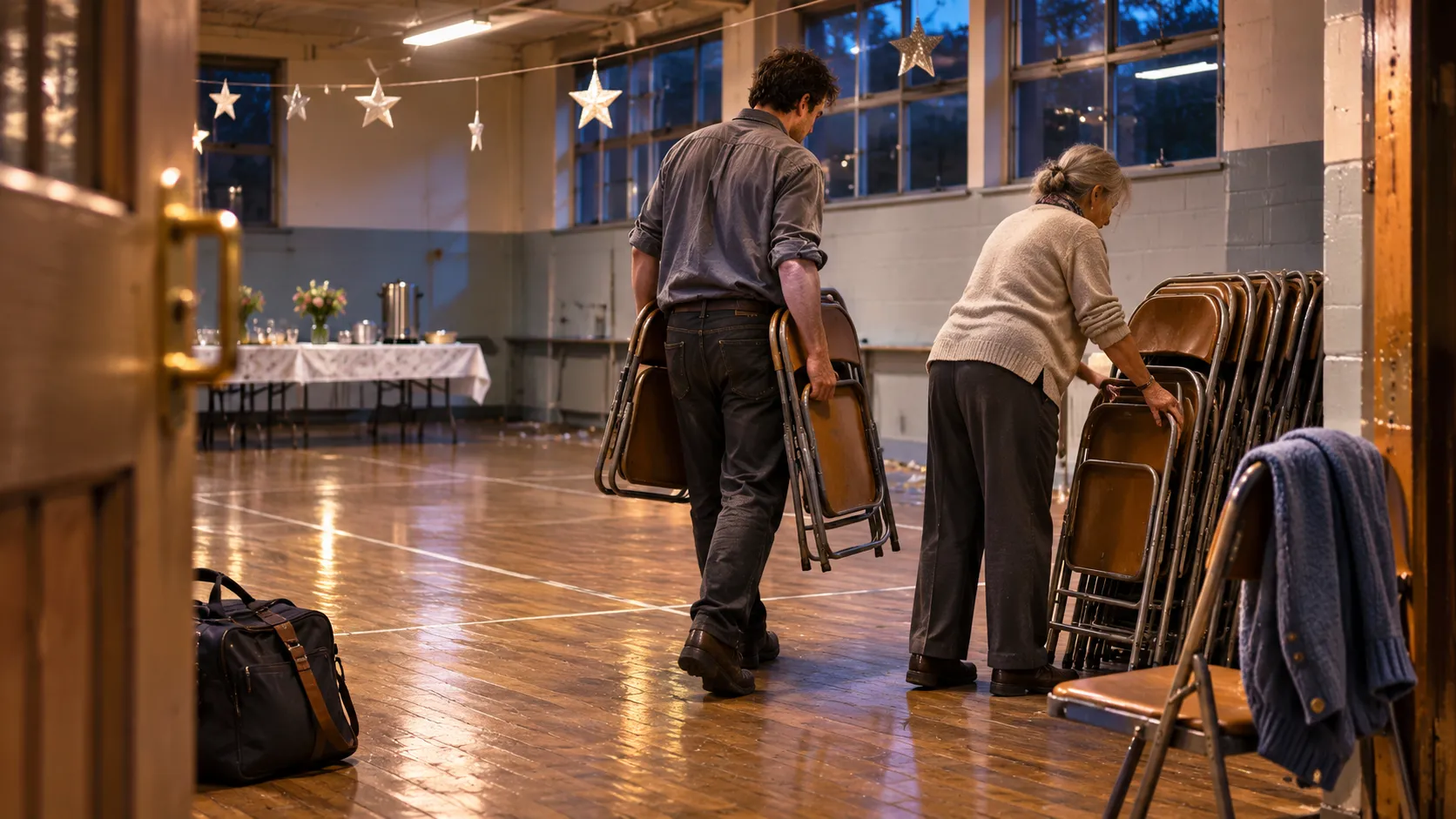
Mum had begun stacking the chairs. She folded one, tipped it sideways and leaned it against the wall. Then she reached for another. The hall was booked until half past nine, and after that the caretaker wanted the place back the way we'd found it.
“I'll do four,” I said, taking hold of a small stack.
“Two will do.”
“I can carry four.”
“I know you can. There's no need to break your back.”
I carried four anyway, but set them down gently, one at a time. She folded two more. We worked without talking, lifting the long legs off the floor before the hinges could scratch the varnish. The room made different sounds when nobody was in it: a chair foot touching wood, the rustle of a paper star, the soft thump of my travel bag when I moved it out of the way.
I remembered other halls, other family gatherings, and the sight of Mum wiping tables while I searched for my shoes. At school events she'd collected stray coats. At weddings she'd found safety pins. Once, after a neighbour's party, she'd stayed so long to help that I fell asleep on a bench waiting for her. I used to think the work was simply something she liked. It occurred to me that perhaps she liked the people and had learned the work was how gatherings ended.
“Do you want me to take the tape down?” I asked.
She reached into a pocket and handed me the roll, nearly empty. The simple efficiency of the gesture made me laugh.
“Prepared.”
“Always.”
I stood on a chair and began peeling the paper stars from the wire. Some came off cleanly. Some tore a little at the point, leaving a pale shape of tape behind. I put the intact ones in a cardboard box. Mum said Jo would use them again.
Eight fifty-two.
Nine o'clock
At the foot of the stairs, a door opened and the caretaker called up that the keys were due at ten. He had his coat on already.
“Won't be long,” Mum answered.
She looked at my bag near the doorway and then at the watch I'd just checked.
“You'll miss your train.”
There was no accusation in it. She said it the way she might have said the tea's gone cold. A piece of information I could use or not use.
“I know.”
“You can go. I'll manage the rest.”
And she would. That was the difficult thing about the offer. She had managed enough rooms and enough birthdays to know exactly how to get through this one.
I thought of the station clock, the platform lights and the warm carriage waiting to leave. If I went now, I'd make it, just. I could send her a message from the train: Lovely evening. Sorry I couldn't help more. She would reply: Don't worry. Glad you came. We had exchanged versions of those sentences before.
Mum turned back toward the chairs. She hadn't asked me to stay.
I took off my coat, placed it beside the cake and moved my bag against the wall.
“There's another train tomorrow,” I said.
She looked up, surprised. Then she gave a short laugh and shook her head.
“There's always another train,” she said.
It wasn't a speech. It didn't need to be.
I unfolded one more chair, then realized I had done the wrong thing and folded it again. Mum laughed harder at that, and for a moment the hall sounded almost as full as it had an hour earlier.
At nine, somewhere beyond the lit windows, a train left without me.
The things you can carry
We finished the chairs together. She wiped the table; I collected the stars. We found three forks, a missing glove and a paper plate with one perfectly untouched slice of cake. Mum wrapped the cake and put it in the bag she was taking home.
“For breakfast,” she said.
I almost said that cake was not breakfast. It was exactly the sort of remark she would have made to me when I was twelve. Instead I found a lid for the container and pushed it into place.
“Good plan.”
She was tired; I could see it when she bent down to retrieve the last ribbon. I was tired too, and my feet hurt from shoes I had chosen for a party rather than a long day on a wooden floor. But we weren't rushing anymore. There was no train on the other end of the task.
While I gathered the tablecloth, Mum told me which cousin had recently learned to drive and why Jo was thinking of changing jobs. I learned that the neighbour who had lent us the speaker was repairing his kitchen and that the silver cardboard letters had been saved from another birthday years ago. I had spent the party being photographed with people I rarely saw; now, with my sleeves rolled up, I was hearing what their ordinary weeks were like.
I didn't make a promise to come more often. It was too easy to promise things after a good evening. I asked instead whether she wanted help carrying the boxes downstairs.
“Yes,” she said. “If you take the light one.”
I took the heavier one. She pretended not to notice.
The double doors
At ten past ten the caretaker stood at the foot of the stairs, holding his keys. We'd kept him waiting ten minutes. He didn't seem delighted, but he took the folded tables from us without complaint and checked the lights one by one.
Mum switched off the last row. The hall changed from a place where people had been to a room that would be opened for somebody else's event tomorrow. The pale strings hung bare. We closed the double doors and heard the lock turn.
Outside, the air was colder than I expected. Mum lifted the bag with the cake inside it. I carried the box of stars and her cardigan, folded over my arm.
“Where will you sleep?” she asked.
“I'll get a room nearby. Catch the morning train.”
She considered that, then nodded. No fuss, no claim on the rest of my night.
We stood beneath the light above the entrance while the caretaker went to his car. I wanted to tell her something about how much work she'd done, how I hadn't seen it, how I'd missed evenings like this before. The words felt too large and too late for the pavement outside a sports hall.
So I handed her the cardigan.
“You left this behind again.”
“I did,” she said, and smiled.
She tucked it into her bag alongside the slice of cake. We started walking toward the corner, not quickly. There was nothing left to catch.
About the Song
- Released
- Album
- OUT OF ORDER, IN TUNE